
The ghosts that never left: To understand magical realism, we need to look at colonial violence.
By Isabella Utria Mago
In its simplest definition, magical realism describes a literary mode in which fantastical or supernatural elements are woven into everyday life as a natural, ordinary part of the world. Understood that way, the ‘magical’ would be something the writer chooses to add, an ornament laid over reality. This description takes for granted that we already agree on what reality is, and that is precisely what magical realism contests. In most of the places where it took shape, the boundary between the real and the impossible was never neutral. It was drawn by colonisation and enforced by governments, missionaries, archives and armies. That boundary decided which bodies, memories and ways of knowing were permitted to exist as ‘real’.
The term itself has a history of displacement. It first appeared in 1925 in German art criticism, when Franz Roh[1] spoke of magischer Realismus to describe post-Expressionist[2] painting. Two years later, the Revista de Occidente[3] published a Spanish translation of his book, carrying the term across the Atlantic. In 1948, Arturo Uslar Pietri[4] used it to refer to short stories by Venezuelan authors. A year later, Alejo Carpentier[5] proposed his own formula, lo real maravilloso americano[6], precisely to distance himself from the European gaze. From the 1950s onwards, English-language academic criticism, and later the publishing market of the Boom[7], turned the expression into a literary category and a brand. It was later extended to writers from Africa, the Caribbean, South Asia and their diasporas. From a German art critic to Latin American literature (and beyond), the history of magical realism is also a history of cultural translation, appropriation and colonial power. It was born in Europe as a label, reappropriated in Latin America and sent back out into the world as a stamp of the ‘exotic’.
This essay reads magical realism through the figure of the ghost. Not the Gothic ghost[8] that returns from the past to disturb the present, but a ghost that never left. Within this framework, the apparition is not a supernatural event but a political condition, the visible persistence of a historical reality that has not been resolved, acknowledged or repaired, close to what Derrida called hauntology[9], the logic of what is neither fully present nor entirely gone. Like magical realism itself, hauntology is a European label that travelled south, where it was taken up and laid over other histories; this essay approaches it with the same caution, since the ghost it follows owes more to the histories it discusses than to the theory. What appears supernatural may simply be that which an official history declared over, erased and silenced, and which refuses to end. Read this way, magical realism is a refusal of disappearance (and not an escape from history), contesting the idea that a person, a massacre, a cosmology or a culture ceases to exist because the official record says so.
The question remains of what it means to use the term today. This text accompanies a conversation with the writer and researcher Sanabel Abdel Rahman on Palestinian magical realism and the politics of the imagination, which gives the question a different weight. In Palestine, where we speak of a Nakba[10] that did not end in 1948, the disappearance of villages, of landscapes, of names, of bodies and of stories is an ongoing process rather than a memory. Emile Habibi’s novel, known in English as The Secret Life of Saeed the Pessoptimist[11] (1974), carries the word disappearance in its original Arabic title. Its protagonist embodies the condition that a 1950 Israeli law termed that of the ‘present absentees’[12], Palestinians displaced within their own country and stripped of their property. Few figures come closer to the ghost this essay sets out to think through, but to reach it, we must first go back to the places where the boundary between the real and the impossible was drawn.
The ghost appears here in four forms. It is the ancestor whose presence persists, the witness to what the archive cannot tell, the symptom of a violence that continues to act and, finally, the commodity, as magical realism itself becomes a marketable category under the exoticising gaze of the publishing market. Each of these figures opens its own interrogation. Who decides what counts as real? What can the unreal bear witness to that the archive cannot? Why does colonial and capitalist rationality so often look like a nightmare when seen from within? And how did a literature written against the colonial gaze come to be consumed through it?
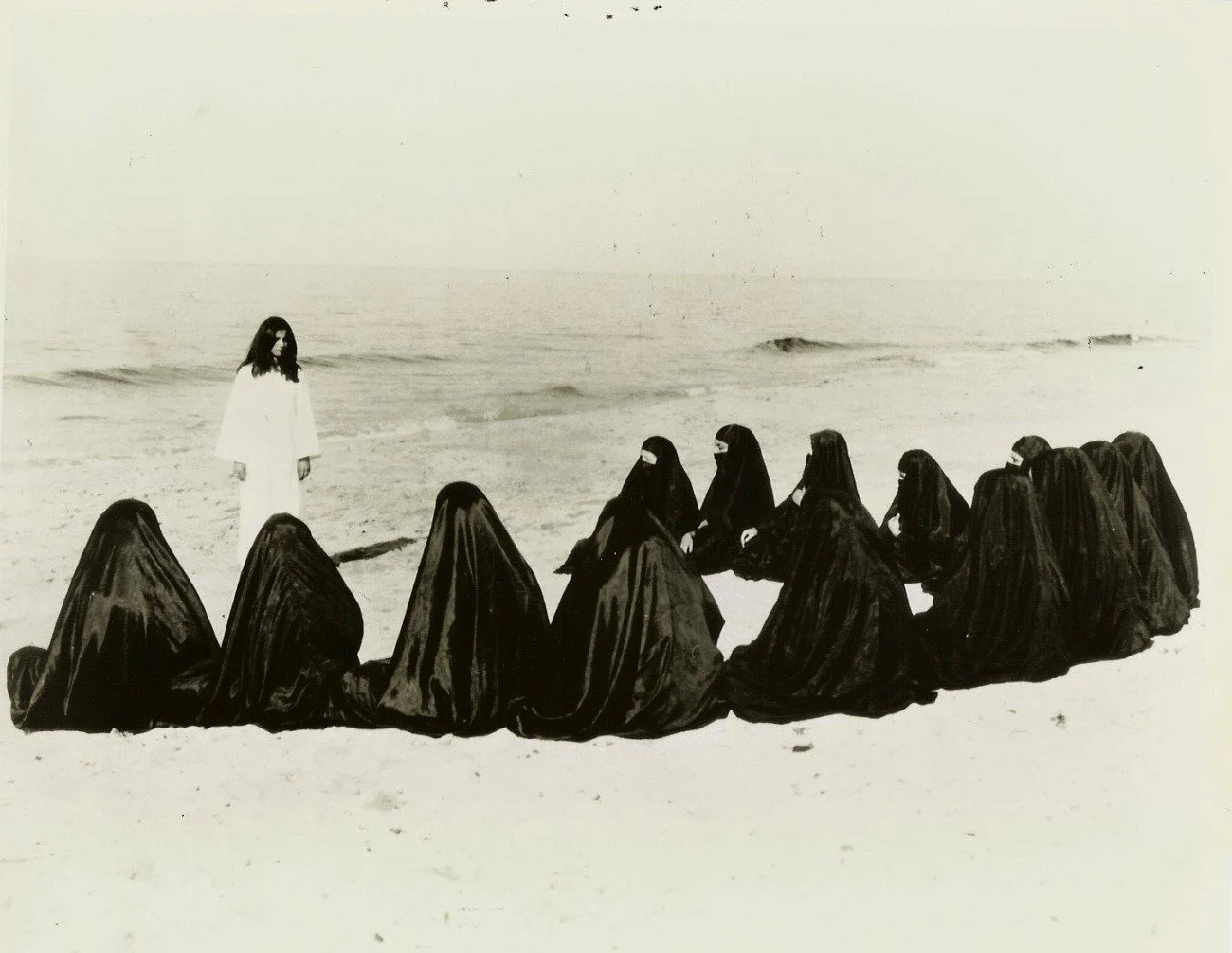
Leila and the Wolves, Heiny Srour, 1984.
I. The ghost as ancestor: which reality, and whose?
Alejo Carpentier travelled to Haiti in 1943. The prologue to The Kingdom of This World (1949), the novel born of that journey, sets out what he called lo real maravilloso americano. Carpentier set it against European Surrealism[13], which in his view manufactured the marvellous by formula, through calculated juxtapositions and staged strangeness. In the Americas, he argued, there was no need to invent the marvellous, as it arose from the history, the landscape and the faith of those who lived there.
The novel’s best-known scene shows what this means in practice. Mackandal, a houngan[14] and maroon[15] who led a campaign of poisonings against the colonists of Saint-Domingue, is captured and burnt in the public square. The enslaved crowd watches him break free and escape, transformed; the colonisers watch him burn and go home convinced that order has been restored. Carpentier does not choose between the two versions. The same square holds two realities that the text refuses to rank.
This refusal matters because colonialism was, among other things, a system for ranking realities. It seized land and labour, and it also organised knowledge: European science and Christian theology sat at the top, while Indigenous and African cosmologies were placed beneath them, renamed as superstition, idolatry, witchcraft and folklore. Aníbal Quijano[16] called this the coloniality of power, and Boaventura de Sousa Santos[17] names its outcome epistemicide[18], the death of ways of knowing. Within this hierarchy, the dead who remain among the living, the ancestor who is consulted or the river that acts were treated not as another form of knowledge but as errors.
The vocabulary we have inherited carries that hierarchy inscribed within it. Europe knows, and the colonised believe. To ask who is permitted to believe in ghosts is to accept that framework, because it places the ghost from the outset in the category of belief. A more precise question would be who is permitted to know that the dead are present. In many Indigenous and Afro-diasporic worldviews, the ancestor is not supernatural at all but belongs to the community, with obligations and a voice. Magical realism writes from inside that normality, which is why tone matters so much. Gabriel García Márquez often said that he learnt his voice from his grandmother, who recounted the most extraordinary things in an entirely matter-of-fact way. Magic is only magic when seen from outside.
García Márquez’s One Hundred Years of Solitude (1967) engages with this tension directly. In Macondo, José Arcadio Buendía is astonished by magnets, magnifying glasses and scientific instruments. Meanwhile, the ascent into heaven of Remedios the Beauty is recorded almost in passing, and Father Nicanor’s levitation barely arouses curiosity. The novel inverts what counts as ‘marvellous’, with European technology arriving as sorcery and the supernatural treated as domestic, so that the reader’s surprise reveals where they stand.
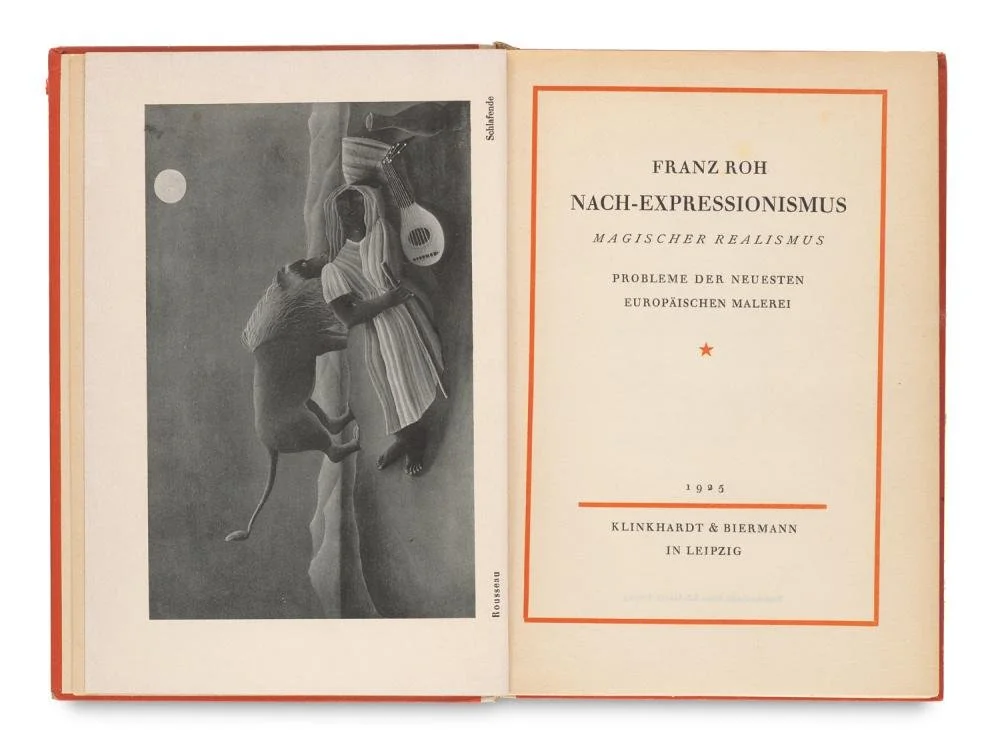
Nach-Expressionismus: Magischer Realismus (1925) by Franz Roh
II. The ghost as witness: the unreal as testimony
In Juan Rulfo’s Pedro Páramo[19] (1955), Juan Preciado arrives in Comala in search of his father and finds a town of the dead, whose voices and murmurs are all that remains after the cacique’s[20] violence emptied it. The novel’s structure is its argument. The dead tell the story because there is no one else left to tell it. The ghosts are the last witnesses, not a fantastical addition to a realist narrative.
The most discussed example of the unreal as testimony is the Banana Massacre (Spanish: Masacre de las bananeras). In December 1928, striking workers gathered in Ciénaga, in Colombia’s Magdalena region, to protest against the United Fruit Company. The army opened fire on the crowd. The Colombian military authorities initially reported only a few dozen deaths, with General Carlos Cortés Vargas acknowledging 47 casualties. Contemporary reports gave higher figures, and a US diplomatic dispatch of 29 December cited an estimate of 500 to 600 deaths from the United Fruit Company’s legal adviser. By January 1929, another US diplomatic dispatch, quoting the company’s representative in Bogotá, reported that the number of workers killed by the Colombian military exceeded 1,000. The exact death toll remains disputed. The problem was never that nobody knew, but how memory was managed, who was allowed to count the dead and which account could remain as history.
In One Hundred Years of Solitude, José Arcadio Segundo survives the gunfire and wakes on a train loaded with corpses that are to be thrown into the sea. When he returns to Macondo, no one believes him. The official version prevails: there were no dead, and the workers went home. Aquí no ha pasado nada (‘Nothing happened here’). What is fantastical in this episode is not the massacre itself, which the novel narrates with an almost documentary coldness, but the collective forgetting that follows, which acts like a spell cast over the whole town. The novel had anticipated this long before with the insomnia plague, when Macondo begins to lose its memory and its inhabitants label things so as not to forget what they are and what they are for. Forgetting was a threat in Macondo long before it became state policy.
García Márquez later said that he raised the death toll to three thousand to fit the novel’s proportions, and the number has circulated ever since as if it were historical fact. Its afterlife is telling, because where the archive produced silence, the novel produced memory. The Colombian state’s recent recognition of the massacre as a state crime might seem to confirm that the novel was right all along. But it is more accurate to say that the novel kept open a question that the state had sought to close. Rather than offering proof in a forensic sense, the ghost bears witness by keeping the case from being filed away.
Toni Morrison’s Beloved[21] (1987) turns that testimony into a body. Drawing on the story of Margaret Garner, the novel brings the murdered daughter back as a young woman who takes up space, eats, demands and remembers. Beloved is not the past coming back but proof that the past never went anywhere or, in Saidiya Hartman’s words, the afterlife of slavery. In Ghostly Matters (1997), Avery Gordon reads Beloved alongside the disappeared of the dictatorship in Argentina[22]. She argues that ghostly presence is one of the ways in which abusive systems of power make themselves felt in daily life, above all when they are assumed to have ended.
The figure of the disappeared in Latin America shows this in all its starkness. The disappeared are neither alive nor dead, and their bodies are hidden so that no crime can be named. The state’s method consists in producing ghosts, the ghost embodying not a metaphor but the form taken by a violence designed to leave no body behind.
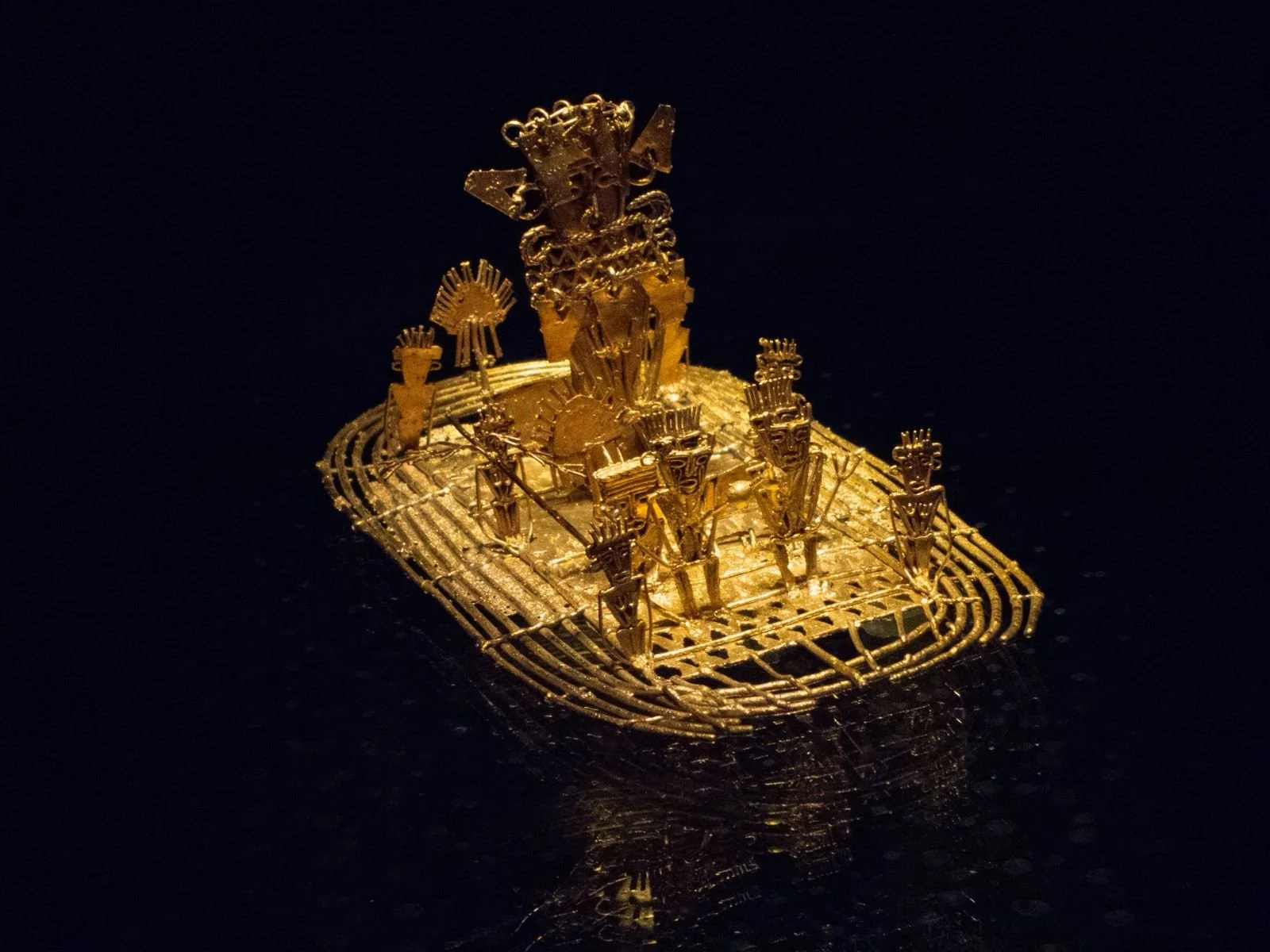
The Muisca raft, a pre-Columbian gold figure evoking the ritual that gave rise to the legend of El Dorado.
III. The ghost as symptom: the irrationality of ‘rational’ systems
Rather than asking, as critics often do, why writers from colonised countries introduce magic into reality, we might ask what colonial history looks like from the perspective of those who lived through it.
Consider the Requerimiento[23], the legal text that Spanish conquistadors were required to read to Indigenous peoples before attacking them, informing them that the Pope had granted their lands to the Crown of Castile, demanding their submission and declaring that any resistance made the war that followed legitimate. It was read in Spanish to people who did not speak Spanish, sometimes from ships far off the coast or before villages already abandoned. Or consider Potosí[24], a mountain of silver that consumed Indigenous lives through forced labour and helped to finance a European economy on the other side of the ocean. Consider, too, the Atlantic crossing of the enslaved, whole landscapes remade for plantation crops, languages forbidden and hidden gods renamed as saints. Measured by any standard of reason, these events look more like a nightmare than the sober realism of the nineteenth-century novel. Carpentier asked what the history of the Americas was, if not a chronicle of the marvellous real, which is not always a source of wonder but more often one of horror.
Gold tells the same story from the other side: at Lake Guatavita, in the Colombian highlands north-east of present-day Bogotá, Muisca[25] rulers were covered in gold dust and carried by raft onto the lake to make an offering of gold to the waters, a rite that reached the Spanish as the legend of El Dorado[26]. The conquerors dismissed Indigenous offerings as idolatry, yet sent expedition after expedition in search of a golden kingdom that did not exist, even attempting to drain the lake itself; in the end, it was they who believed in the enchanted object. Much of the gold they did find, including the finest goldwork, was melted into bullion and shipped across the ocean. The hunger for gold outlived the empire. Centuries later, in Chocó, in north-western Colombia, illegal gold mining contaminated the Atrato River with mercury, and in 2016 the Constitutional Court recognised the river itself as a subject of rights, a legal status strikingly close to the cosmologies that colonial reason once dismissed as error.
The pattern is not only Latin American. In the Congo Free State, which Leopold II of Belgium ruled as his private property from 1885 to 1908 in the name of humanitarian and civilising work, rubber quotas were enforced by armed troops who had to account for every bullet with a severed hand[27]. The whole system ran on ledgers, concessions and dividends. In China, Britain fought two wars[28] between 1839 and 1860 to keep its merchants free to sell opium grown in British India, in the name of free trade, and the treaties that ended them opened ports, ceded Hong Kong and legalised the drug the Qing authorities had tried to ban. In both cases the vocabulary was that of commerce and reason, and what it describes reads like a nightmare. From this angle, magic is not what is strange. What is strange is history.
The same logic runs from colonial extraction to modern capital. In García Márquez, the company arrives almost imperceptibly, with a man tasting a banana at the Buendías’ table, before transforming everything, turning the banana plantation from a backdrop into a force that reshapes the world of the novel. The foreigners alter the pattern of the rains, hasten the harvests, divert the river and build a town fenced in with barbed wire. After the massacre, it rains for four years, eleven months and two days. The company’s power reads like a force of nature because, for those who live under it, it operates as something sovereign and unaccountable, capable of rewriting both geography and memory.
The most chilling moment of the episode is also the most rational. When the workers take their demands to court, the company’s lawyers prove that the workers do not exist, since men hired on a temporary basis had never, in the eyes of the law, been employees at all, and so the company had never had any employees. The law turns the living into ghosts before the army turns them into corpses. Contracts, courts and markets present themselves as reason itself, yet the violence they unleash is of a kind no reason can explain. What returns as ‘magic’ in the novel is the symptom of that contradiction.
Colombian documentary cinema arrived at the same insight by another route. Nuestra voz de tierra, memoria y futuro (1981), by Marta Rodríguez and Jorge Silva, was made over five years with the Coconuco community of Cauca, in south-western Colombia, during the early years of the Regional Indigenous Council of Cauca (CRIC) and its struggle to recover ancestral land. The film refuses to keep documentary and myth apart; it weaves the ghosts and magical beliefs of the community’s oral tradition into the record of that struggle, to show a domination that runs unbroken from the conquest to the present. Myth does not replace the evidence here; it is the form testimony takes when it is told by those who lived through the dispossession.
The device persists in more recent Colombian cinema. Camila Beltrán’s Mi bestia[29] (2024) is set in Bogotá in 1996, where the rumour that the devil will arrive with a lunar eclipse circulates alongside news reports of missing girls. Those disappearances are not an invention of the film. In Colombia, girls have gone missing, and still do, for reasons no prophecy explains[30]. For Mila, who is thirteen, the prophecy becomes a way of naming the changes in her own body and a threat that is patriarchal and entirely real. Here the devil is less a supernatural being than the shape a society gives to the violence it will not name.
Magical realism, then, is not an escape from political reality so much as a way of seeing it more clearly; its exaggerations are a form of accuracy, and its impossibilities are drawn to the right scale for events that official realism would shrink.
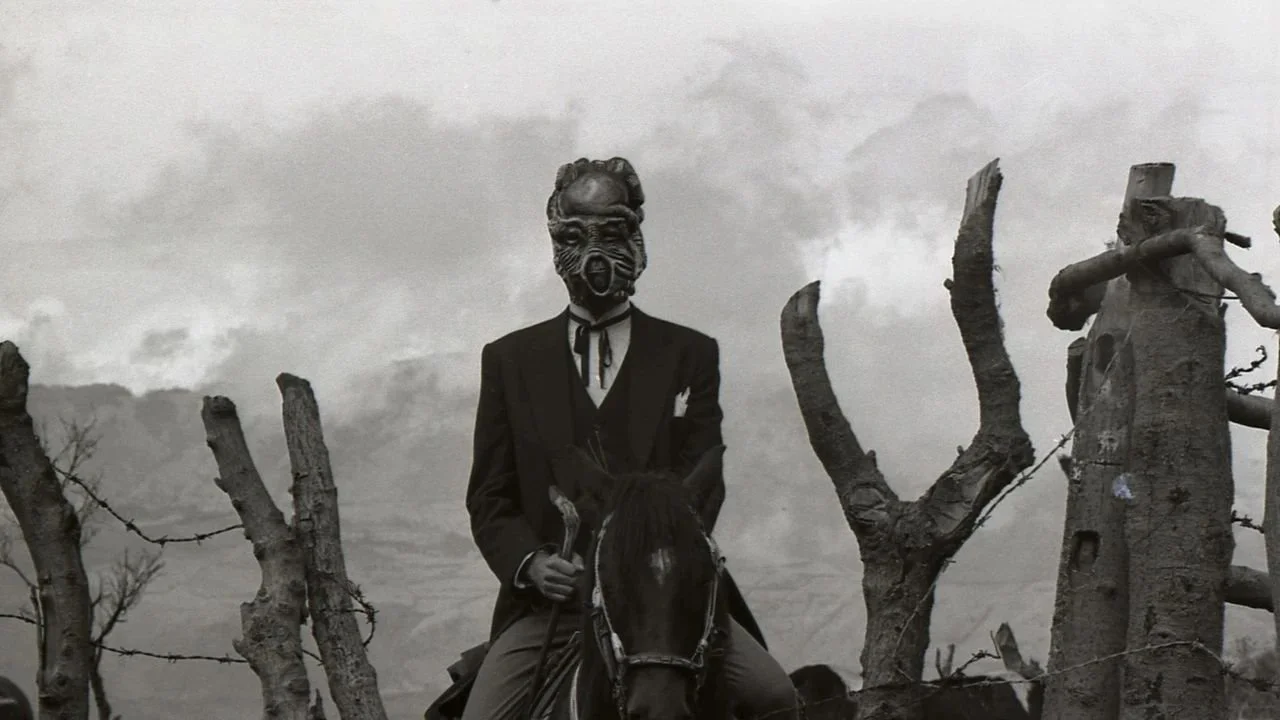
Nuestra voz de tierra, memoria y futuro, directed by Marta Rodríguez and Jorge Silva, 1981.
IV. The ghost as commodity: the gaze that makes it ‘magical’
During the Boom of the 1960s and 1970s, driven largely by Barcelona publishers and an expanding international market for translations, magical realism became something like Latin America’s brand. The package was recognisable, full of colourful towns, ghosts, lush landscapes and communities outside time. A gap opened between what the books did and how they were sold, with the texts insisting on history and the marketing selling timelessness. This is how a novel about a massacre and a forgetting organised by the state could be sold as the story of a charming little town where a man in love is followed by yellow butterflies.
This is where the colonial gaze returns. Magic becomes proof that reason has not yet fully reached the Global South, which is fascinating precisely because it is imagined as premodern. The ghost, once a witness, becomes scenery. The worldwide success of magical realism has at times reproduced the very hierarchy that its best works dismantle. The coloniser once filed Indigenous and African knowledges under the heading of superstition, and the reader or publisher who files these novels under the heading of the exotic makes the same gesture with better manners.
The label, moreover, kept travelling. Once established as a Latin American brand, it began to be applied to writers from other regions, often from outside and without their having claimed it. Works emerging from very different histories were read through a mould already set, as if any literature from the South that did not conform to European realism had to be a variation on Macondo. The cultural translation that had carried the term from Europe to Latin America was now repeated in reverse: the category arrived before the books.
Some writers pushed back against this expectation, most notably in the 1996 anthology McOndo, edited by Alberto Fuguet and Sergio Gómez, which rejected the idea that Latin American writers should supply magic and instead presented a Latin America of shopping centres and cable television. Toni Morrison distrusted the label for similar reasons, as it allowed readers to treat the dead daughter as a literary device instead of reading the aftermath of slavery as fact.
None of this means that the genre is inherently resistant. A European strand, from Roh to Massimo Bontempelli, developed largely outside the colonial histories that shaped its later Latin American forms, while some Latin American works sit comfortably within the very market that consumes them. The claim here is narrower: some of the most powerful works of magical realism are inseparable from the histories to which they respond, and reading them without those histories risks reproducing the very erasure against which they were written.
Nor are these histories confined to Latin America. At the First Congress of Black Writers and Artists in Paris in 1956, Jacques Stephen Alexis rooted a réalisme merveilleux des Haïtiens[31] in Haitian popular culture and the country’s revolutionary history. In Ben Okri’s The Famished Road (1991), Azaro is an abiku[32], a spirit child caught between the living and the dead, as Nigeria moves towards independence. The grotesque postcolonial dictatorships of Sony Labou Tansi[33] and the Caribbean histories of Maryse Condé[34] belong to the same territory. Magical realism is not a regional speciality. It is a recurring response wherever colonial history turned the boundary between the possible and the impossible into a political question.
Édouard Glissant’s defence of the droit à l’opacité[35], the right not to be made transparent to another’s understanding, offers a way of reading these works without consuming them. It means resisting the temptation to explain the magic in terms comfortable for the reader, whether as symbol, as metaphor or as local colour. The ghost owes us no explanation; it is we who owe it our attention.
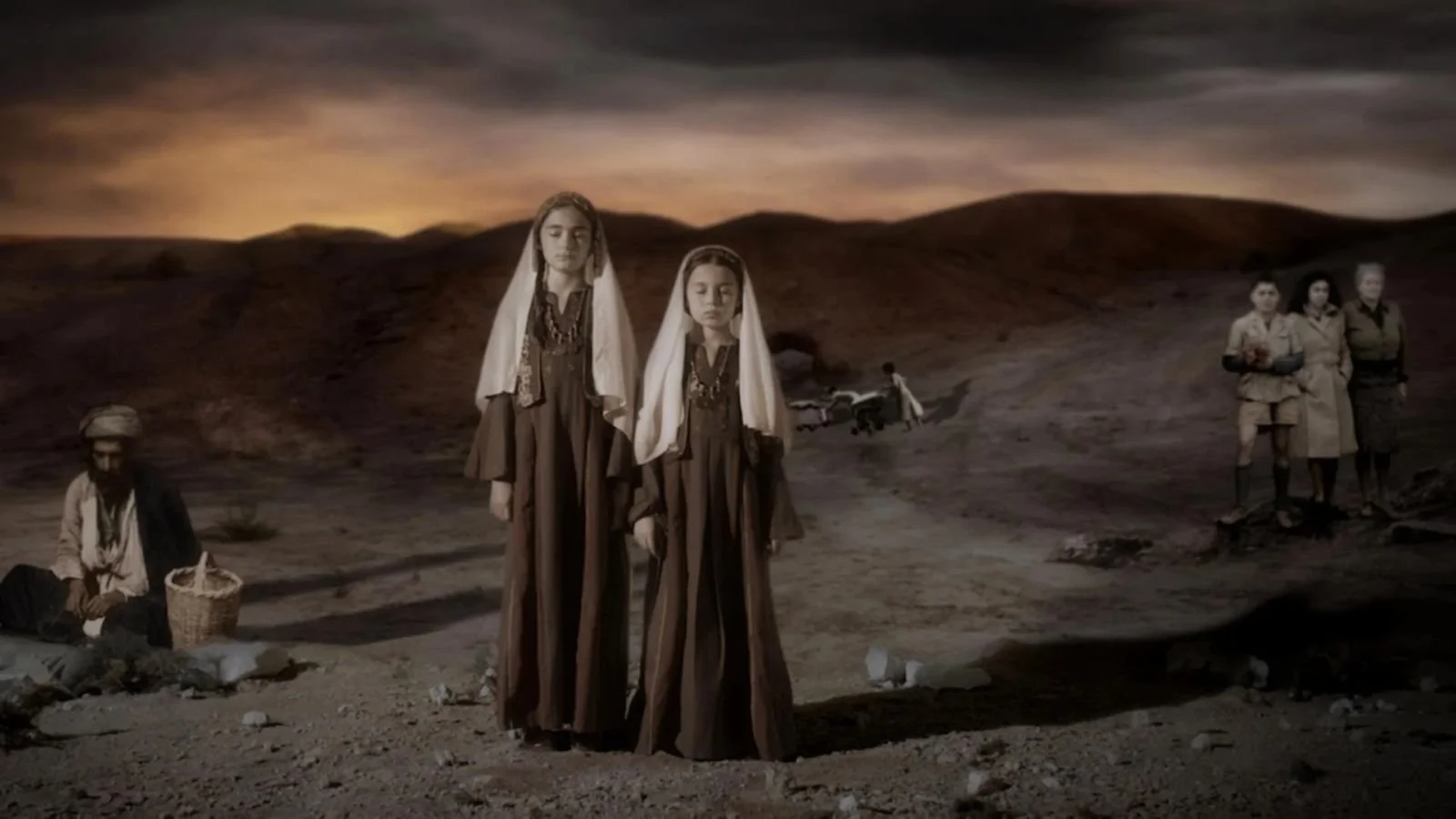
In the Future, They Ate from the Finest Porcelain, directed by Palestinian artist Larissa Sansour and Danish artist Søren Lind, 2015.
Conclusion: what it means to use the term today
Colonialism does not only seize land and labour; it also seeks to control the historical narrative. That means deciding which events took place, which deaths count and which ways of knowing the world can be recorded as knowledge. Against this, magical realism does something formal that is also political. It allows contradictory versions of events to coexist. A person can be dead and present, a massacre can be remembered and officially denied at the same time, an ancestor can remain part of daily life, Mackandal burns and flies free in the same square.
The question is not so much why writers bring the impossible into the everyday as why certain histories charged the boundary between the possible and the impossible with politics. Wherever a single authorised narrative has served as an instrument of domination, what comes closest to the real may lie where perspectives and narratives cross. Historical memory is either plural or incomplete.
What, then, does it mean to use the term today? The genealogy traced in this essay makes it an uncomfortable word: it was born in Europe, became a brand and still drags along the gaze that turned witnesses into scenery. To use it without that history is to repeat the exoticising gesture. However, to read it through that history makes it possible to name a practice that contests what counts as real wherever reality has been administered by force.
Palestine makes that contest particularly visible. Between 1948 and the present, entire villages have been erased from maps, their names replaced, their landscapes transformed, and the people who lived there scattered within and beyond their land. Emile Habibi answered that reality with satire, the absurd and the fantastic, to the point of having a being from outer space rescue his protagonist. The legal category of ‘present absentees’, created by the 1950 Israeli law, recalls the banana workers whom the company’s lawyers declared non-existent. In both cases, the law manufactures ghosts before literature names them.
Cinema has taken up the same task. In Heiny Srour’s Leila and the Wolves[36] (1984), a Lebanese woman living in London notices that an exhibition of Palestinian photographs shows only men. She sets off through decades of Palestinian and Lebanese history, drifting like a witness outside time, while re-enactments and documentary footage bring back the women whom the archive erases twice, once along with their people and again within the history of the resistance itself. More recently, in Larissa Sansour and Søren Lind’s short film In the Future They Ate from the Finest Porcelain (2016), a resistance group buries fine china so that future archaeologists will find evidence of a people whose existence is denied. Fiction produces the archive that official history refuses to keep, as the figure of three thousand dead did in Macondo.
Here, imagination ceases to be an ornament and becomes territory. When the land, the return and the continuity of a people come to be deemed impossible, imagining them is a way of continuing to inhabit them. That is perhaps why the conversation accompanying this text speaks of a politics of the imagination. In certain contexts, the impossible is not the opposite of the real, but what remains of it once it has been expropriated.
Understanding magical realism therefore requires holding two things at once: the violence it responds to and the colonial gaze through which we learnt to read it. The ghost explains both why this literature exists and how it works. It exists because something that history declared finished has not finished. It works by staying, by refusing to be exorcised, explained or turned into scenery. Nayra, the word for the past in Aymara[37], also means ‘the eye and what lies in front’, while the future lies behind. Silvia Rivera Cusicanqui[38] has drawn from this a way of thinking history in which the past is not left behind but faced, and magical realism writes from within that orientation. Ghosts are not visitors from another world; they are the part of this world that official history has not yet managed to disappear.
[1] Franz Roh (1890–1965), German art historian, critic and photographer. His book Nach-Expressionismus. Magischer Realismus: Probleme der neuesten europäischen Malerei (1925), roughly ‘Post-Expressionism. Magical Realism: Problems of the Most Recent European Painting’, introduced the term.
[2] Roh’s term for the painting that emerged in Europe after the First World War, which absorbed the lessons of Expressionism while turning against its distortions, returning to precisely rendered objects and everyday scenes charged with an uncanny stillness.
[3] Cultural journal founded in Madrid in 1923 by the philosopher José Ortega y Gasset, which also ran a publishing house and played a key role in bringing contemporary European, and above all German, thought into Spanish. Its 1927 edition of Roh’s book, translated by Fernando Vela, turned the German subtitle into the main title, Realismo mágico.
[4] Arturo Uslar Pietri (1906–2001), Venezuelan novelist, essayist, diplomat and politician. He used the term ‘realismo mágico’ for the Venezuelan short story in Letras y hombres de Venezuela (1948).
[5] Alejo Carpentier (1904–1980), Cuban novelist, essayist and musicologist, born in Lausanne. He lived in Paris from 1928 to 1939, close to the Surrealist circle he would later criticise, and in Caracas from 1945 to 1959.
[6] Literally ‘the American marvellous real’, where ‘American’ refers to the Americas as a whole. Carpentier’s term for a marvellous that is not invented but found in the history, landscape and beliefs of the continent, first set out in the prologue to The Kingdom of This World (1949).
[7] The Latin American Boom: the sudden international visibility of Latin American novelists in the 1960s and 1970s, among them Julio Cortázar, Carlos Fuentes, Gabriel García Márquez and Mario Vargas Llosa.
[8] The ghost of the European Gothic tradition that began with Horace Walpole’s The Castle of Otranto (1764): a figure from the past, often tied to an episode of violence, crime, an inheritance or a house, whose return disturbs the present (and the living) until it is laid to rest.
[9] The term was coined by the French philosopher Jacques Derrida in Specters of Marx (1993). In French, hantologie sounds almost identical to ontologie, and the pun names the condition of the spectre, neither alive nor dead, together with the responsibility owed to those who are no longer, or not yet, present. Avery Gordon’s Ghostly Matters (1997), discussed below, gave haunting a sociological and political reading, and the critic Mark Fisher later applied the term to cultures haunted by futures that never arrived.
[10] Arabic for ‘catastrophe’. The term refers to the expulsion and dispossession of around 750,000 Palestinians and the depopulation or destruction of more than 500 towns and villages in 1948, during the creation of the ethnostate of Israel. Many Palestinians, researchers and scholars speak of an ongoing Nakba to describe the displacement and dispossession that have continued since.
[11] Emile Habibi was a Palestinian writer and politician from Haifa. The Arabic title translates roughly as ‘The Strange Events Surrounding the Disappearance of Saeed, Father of Misfortune, the Pessoptimist’. ‘Pessoptimist’ renders mutasha’il (المتشائل), Habibi’s fusion of the Arabic words for pessimist and optimist.
[12] In Arabic, al-gha’ibun al-hadirun. Under Israel’s Absentees’ Property Law of 1950, Palestinians who had left their homes after the United Nations partition resolution of November 1947, even briefly or under duress, were classed as absentees and their property passed to a state Custodian.
[13] Avant-garde movement founded in Paris by André Breton, whose Manifesto of Surrealism (1924) set out to free the imagination from reason and convention by drawing on dreams, chance and the unconscious. Its methods included automatic writing and the unexpected juxtaposition of unrelated objects and images. Carpentier knew the movement from within, and his idea of the marvellous real took shape partly as a break with it.
[14] A male priest in Haitian Vodou, who leads ceremonies, heals and mediates between the community and the lwa, or spirits; a female priest is called a mambo. Carpentier’s Mackandal is based on François Mackandal, a maroon leader burnt alive at Cap-Français in 1758.
[15] From the Spanish cimarrón, first used for domestic animals that had escaped into the wild. It came to designate enslaved people who fled the plantations, many of whom founded free communities, known as palenques in the Spanish colonies and quilombos in Brazil, in the mountains and forests of the Caribbean and the Americas.
[16] Peruvian sociologist, known for having developed the concepts of ‘coloniality of power’ and ‘coloniality of knowledge’. With them he describes how the hierarchies established by colonialism, above all the classification of the world’s population by race and the placing of European knowledge at the centre, outlived colonial rule itself and continue to organise labour, authority and knowledge. See ‘Coloniality of Power, Eurocentrism, and Latin America’ (2000).
[17] Boaventura de Sousa Santos (b. 1940), Portuguese sociologist and founder of the Centre for Social Studies at the University of Coimbra, known for his work on the ‘epistemologies of the South’, set out in Epistemologies of the South: Justice Against Epistemicide (2014).
[18] The destruction or subordination of forms of knowledge other than the dominant Western one, which has accompanied colonial violence and dispossession. For Sousa Santos, there can be no global social justice without global cognitive justice. The Brazilian philosopher Sueli Carneiro has developed the concept in relation to anti-Black racism in Brazil.
[19] Juan Rulfo (1917–1986), Mexican writer and photographer, also author of the short-story collection The Burning Plain (1953). Pedro Páramo (1955), his only novel, unfolds through the voices of the living and the dead of Comala, a fictional town ruined by the power of a single landowner.
[20] From the Taíno kasike, originally the word for a chief among certain Indigenous peoples in the Caribbean, including the Taíno and Kalinago of the Antilles. It was applied by the Spanish to every Indigenous authority, with no regard for the diversity of political systems and titles across the Americas. A royal instruction made this a rule in 1538, ordering that Indigenous rulers be called only ‘caciques’ and never ‘señor’, a title that in Castilian implied real authority and deference. In Latin America, the word later came to designate someone wielding strong political, economic and social power at a local level, and in Pedro Páramo it refers to the power its title character exercises over Comala and its inhabitants.
[21] Toni Morrison (1931–2019), American novelist, awarded the Nobel Prize in Literature in 1993. Beloved (1987), which won the Pulitzer Prize for Fiction in 1988, is set in Ohio after the Civil War and draws on the case of Margaret Garner, who escaped slavery in Kentucky in 1856 and killed her daughter rather than see her returned to it.
[22] During the military dictatorship of 1976–1983, thousands of people were abducted by state forces, held in clandestine detention centres and killed, their bodies concealed. Human rights organisations estimate the number of disappeared at 30,000.
[23]The ‘Requirement’, drafted in 1513 by the royal jurist Juan López de Palacios Rubios, called on Indigenous peoples to accept the authority of the Church and the Spanish Crown, and warned that refusal would bring war, enslavement and the seizure of their property, for which they themselves would be held responsible.
[24]City in the Andes of present-day Bolivia, at the foot of the Cerro Rico, where silver was found in 1545. From 1573, Viceroy Francisco de Toledo adapted the Inca mit’a into a system of forced labour that sent more than 13,000 Indigenous men a year to the mines, where many died from accidents, exhaustion and the mercury used to refine the ore. By around 1600 Potosí had more than 100,000 inhabitants, and its wealth gave Spanish the expression vale un Potosí (‘worth a Potosí’).
[25]Chibcha-speaking people of the eastern Andean highlands of present-day Colombia, organised at the time of the conquest into confederations led by the zipa of Bacatá and the zaque of Hunza. The expedition of Gonzalo Jiménez de Quesada subjugated them from 1537, yet Muisca communities persist today, with recognised councils in Suba and Bosa, in Bogotá, and in Cota, Chía and Sesquilé.
[26]Spanish for ‘the golden one’, a name first given to the gilded ruler and only later to an imagined city or kingdom. The fullest account of the Guatavita rite comes from Juan Rodríguez Freyle’s chronicle El Carnero (1636), and historians still debate how closely it reflects Muisca practice. A small gold votive piece found in 1969 in Pasca, now in the Gold Museum in Bogotá and known as the Muisca raft, shows a chief on a reed raft surrounded by attendants. Spanish and later British ventures tried to drain the lake in the 1580s and again around 1900, and it has been legally protected since 1965.
[27]Recognised at the Berlin Conference of 1884–85 as Leopold II’s personal possession, the Congo Free State declared nearly all land ‘vacant’ and therefore state property, keeping the rubber and ivory trade for itself or its concession companies. Villages were given quotas, enforced by holding women and children hostage, flogging, and burning villages that resisted. International pressure forced Leopold to hand the territory to the Belgian state in 1908, but before doing so he had the records burnt in Brussels. The profits paid for monuments and public works in Belgium.
[28]The First Opium War (1839–1842) ended with the Treaty of Nanking, which ceded Hong Kong Island to Britain and opened five ports to British trade. In the second (1856–1860), fought alongside France, the settlements reached at Tianjin and Beijing opened further ports and legalised the opium trade.
[29]First feature by the Colombian director Camila Beltrán, who weaves real television archives from the period into the fiction and has described Colombian cinema as a form of catharsis in the face of the country’s history. The film’s omens also had real counterparts. Around 6 June 1996, the triple six of the date set off a wave of rumours about the Antichrist in Colombian cities such as Bucaramanga, and on the night of 26 September that year a total lunar eclipse was visible across Colombia.
[30]Colombia’s Truth Commission documented 121,768 victims of forced disappearance between 1985 and 2016, and 16,238 children recruited by armed groups between 1990 and 2017, around 30 per cent of them girls. The disappearances continue. In the first half of 2026, Bogotá registered 538 reports of missing minors, two thirds of them girls. Trafficking, sexual exploitation and forced recruitment are named as possible causes.